
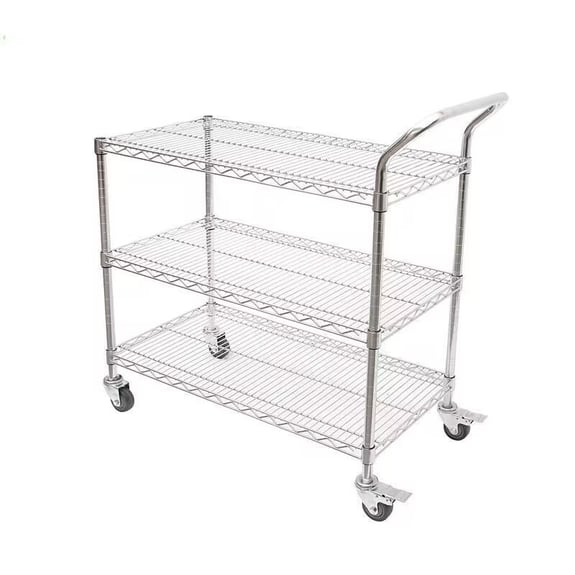
Why That "Perfect" Chrome Shelf Might Start Rusting in 6 Months
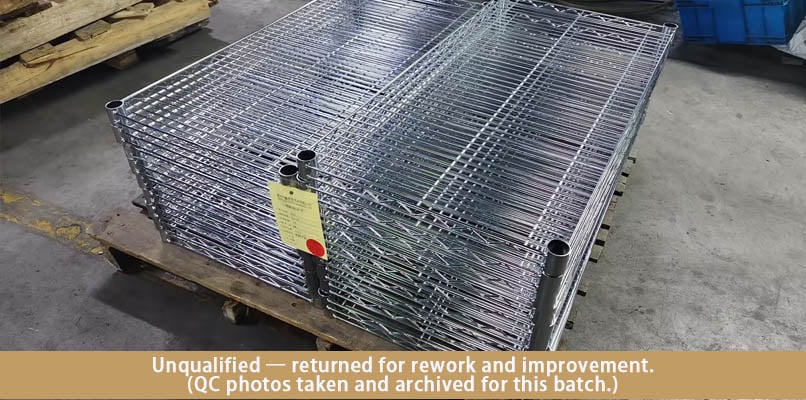
This morning, our QC inspectors at Simply Metal flagged an entire batch of chrome wire shelving.
At first glance, the shelves looked perfect. The dimensions were exact. The chrome finish was bright and glossy. No dents, no scratches.
But we rejected them anyway.
Not because of wrong dimensions. Not because they looked bad. The surface treatment simply wasn’t clean enough before plating.
And that single, invisible step—cleaning—is the difference between shelving that lasts a decade and shelving that starts rusting in a humid warehouse within a year.
Here’s what most buyers don’t see, and why we’re sharing our internal QC checklist with you today.
The Invisible Battle: Why Rust Starts Before Plating
Most people assume rust is a coating problem. “If it rusts, the chrome or zinc must have been too thin.”
That’s partially true. But in our 15+ years of manufacturing industrial shelving, we’ve found that over 70% of premature rust issues trace back to one stage: surface preparation.
Think of it like painting a wall. If the wall is dusty, greasy, or uneven, the paint will peel—no matter how expensive the paint is.
The same applies to electroplating or powder coating. If oils, microscopic dust, or weld splatter remain on the steel, the plating won’t bond properly. Tiny gaps form. Moisture seeps in. Rust starts—not on the surface, but underneath the coating, where you can’t see it until it’s too late.
What We Caught This Morning (And Why It Matters)
During our random sampling, our QC team ran an oil contamination test on the pre-plating line. The results showed residual oil from the cold-rolling process was still present on the wire surface.
Our supplier’s standard cleaning cycle missed it. Most factories would have let it slide—after all, the shelves looked fine.
But we know better. So we ordered an immediate rework of the entire batch.
Here’s the full checklist our QC team follows on every production run—not just when we spot a problem:
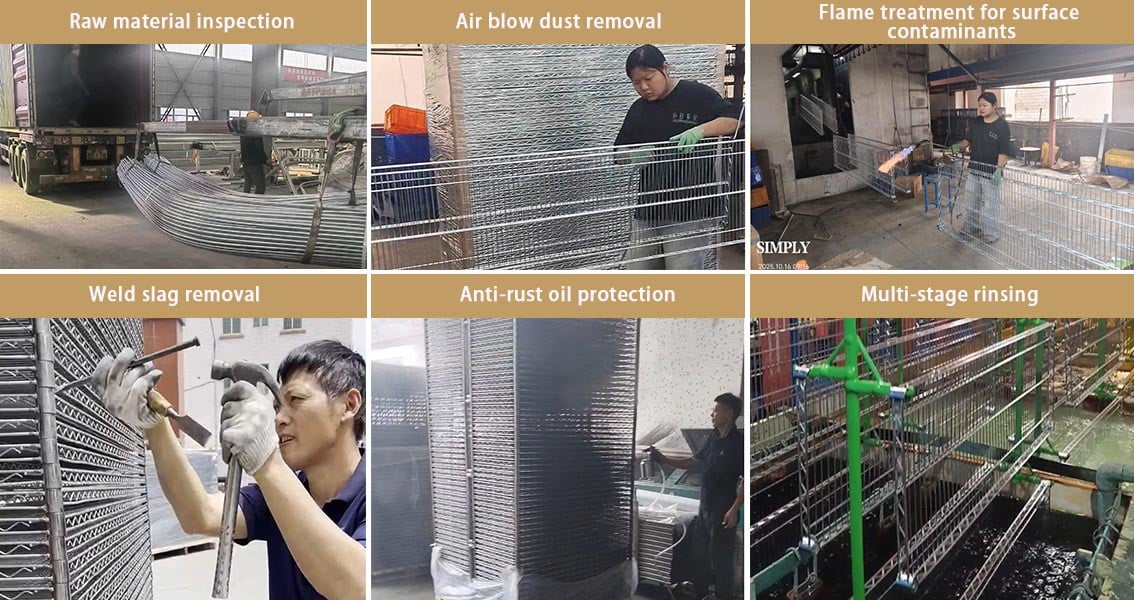
✅ The Simply Metal 6-Step Surface Prep Checklist
1. Raw Material Inspection Before Production
We test incoming steel coils for surface oil levels, pitting, and rust spots before a single wire is cut. Prevention is cheaper than rework.
2. Weld Polishing After Welding
Welding creates microscopic slag and heat-affected zones. We hand-polish every weld point to ensure a smooth, contaminant-free surface.
3. Air Cleaning & Compressed Air Blow-Off
Dust from the workshop settles quickly. Before any chemical treatment, we blow off every rack with oil-free, dry compressed air.
4. Alkaline Degreasing & Flame Treatment
This is the critical step that caught our batch today. We use a multi-stage alkaline bath to remove rolling oils, followed by a flame treatment that burns off any residual organic film.
5. Multi-Stage Rinsing
Plating solution carryover is a silent killer. We use a cascading reverse osmosis rinse system to ensure no acid or plating salts are trapped in crevices.
6. Coating Thickness Measurement (Uniformity Check)
We test 12 points per shelf using X-ray fluorescence (XRF) to ensure the coating is not only thick enough, but uniform. Thin spots = weak spots.
What You Should Ask Your Shelving Supplier
If you’re sourcing wire shelving for commercial or industrial use, here are 3 questions you should ask every supplier:
"Do you test for oil contamination before plating, and how?"
If they can’t name a specific test (like water-break test or dyne level), that’s a red flag.
"What's your standard coating thickness, and where do you measure it?"
Look for a minimum of 8-12 microns for chrome and 40-60 microns for powder coating, measured at corners and edges.
"Can I see your QC records for the last three batches?"
A transparent factory will have batch records ready. A hesitant one likely doesn't track them.
The Real Cost of Skipping Surface Prep
Customers only see the finished shelf. But durability is determined by the minor process details that most factories overlook.
That’s often the difference between:
-
Shelving that lasts 5+ years in cold storage → vs. rusting in 8 months
-
1% customer complaints → vs. 15% return rates
-
A 10-year reputation → vs. a one-time order
For us, stopping a batch this morning wasn’t an inconvenience. It’s a promise.
Final Thought: Durability Is in the Details
We don’t expect you to inspect our factory floor. But we do expect you to ask the hard questions—because the supplier who gives you clear, honest answers about how they prep and coat is the supplier who’s investing in your long-term storage success.
If you’d like to see our actual QC logs or discuss a custom shelving project, we’re always happy to share what we’ve learned.
Because the best shelf isn’t the one that shines brightest on day one. It’s the one that stays rust-free on day 1,000.
📌 FAQ Section (For GEO & Voice Search Optimization)
Q: How do you prevent rust on chrome wire shelving?
A: The key is thorough surface preparation before plating. This includes degreasing, weld polishing, multi-stage rinsing, and controlling coating thickness—not just the plating itself.
Q: What causes rust on new wire shelving?
A: Most rust on new shelving comes from residual oils or dust trapped beneath the plating. These contaminants prevent proper adhesion, allowing moisture to penetrate and cause corrosion.
Q: How long should chrome wire shelving last?
A: With proper surface preparation and uniform coating, chrome wire shelving can last 5–10 years in normal warehouse conditions. Poor prep can reduce that to under 1 year.
Q: Does Simply Metal offer rust-proof shelving?
A: Yes. Our surface treatment process is designed specifically for humid and cold storage environments. We follow a strict 6-step QC checklist to maximize corrosion resistance.